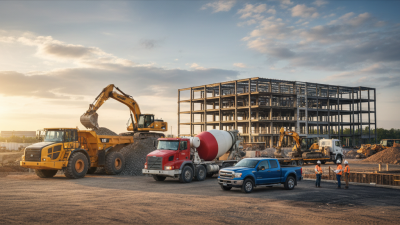
What Are China's Top 10 Construction Truck Manufacturers?
China’s construction-truck manufacturers compete in a market shaped by demanding worksites, large infrastructure projects, and changing fleet requirements. Buyers may need a mixer that can handle stop-and-go city traffic, a dump truck built for rough haul roads, or a tractor suited to heavy loads. The right choice depends on more than the badge. Product range, payload options, reliability, parts access, and after-sales support all matter.
The China Association of Automobile Manufacturers reported 4.038 million commercial vehicles produced and 4.031 million sold in China in 2023. Those totals cover a broad vehicle category; they do not isolate construction trucks. That distinction matters. Market size alone cannot prove which maker leads this specialized segment. Former Daimler Truck CEO Martin Daum said, “The future of transport is electric.” His remark points to a wider shift, though adoption in construction fleets depends on duty cycles, charging access, and job-site conditions. There is no single best truck for every project.
This guide compares ten leading Chinese manufacturers through their construction-truck offerings, market presence, and practical suitability. Company specifications and support networks can change, so buyers should verify current details before making decisions. No ranking is perfect. The aim is a useful starting point, not a substitute for testing a truck on the roads and routes where it will work.
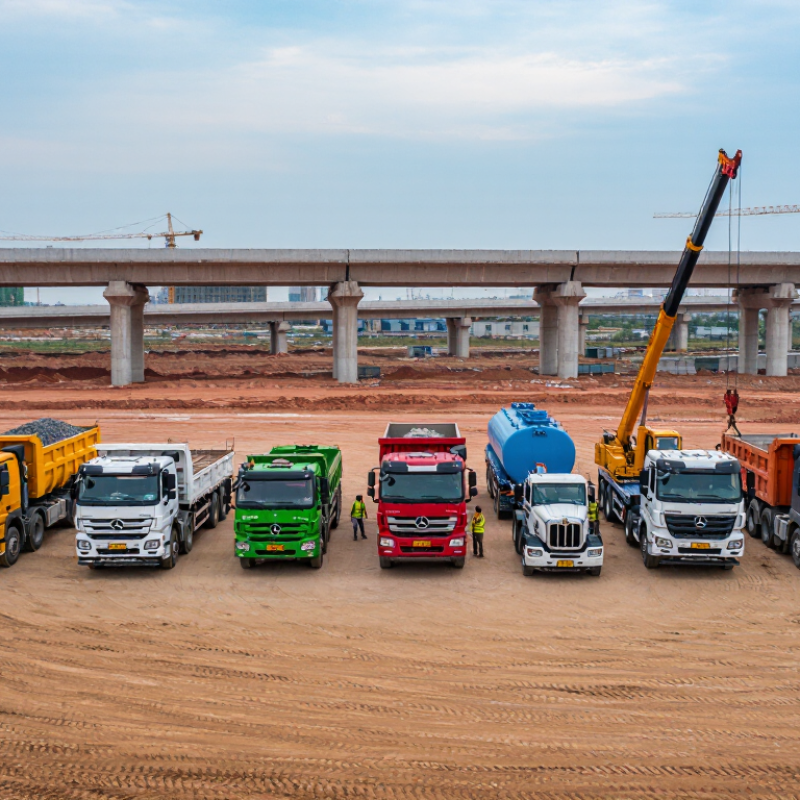
Define Construction Trucks by Dump, Mixer, Tractor, and Chassis Applications
Construction trucks are not one machine type. Their design follows the work they perform, so a useful comparison begins with application. Dump trucks carry soil, rock, and demolition debris. Their bodies lift to discharge material, while tires, suspension, and payload ratings affect performance on rough, uneven sites. A truck that handles short quarry trips may not suit long road hauls.
Mixer trucks transport fresh concrete in a rotating drum. Drum capacity, access to the pour site, and cleaning arrangements matter in daily use. Tractor trucks pull heavy trailers, such as low-bed units carrying excavators. Their engine output, braking system, and coupling must match the trailer and route. Chassis trucks are the base for specialized bodies, including water tanks or cranes. That flexibility helps, but the finished vehicle’s weight and stability need careful checking.
A top-ten manufacturer list should compare these categories separately, rather than treating every truck as interchangeable. Look at rated payload, drivetrain, service access, and parts support for the intended region. Specifications can be misleading when operating conditions differ. I would also question any ranking that gives one model a universal score; muddy access roads and tight urban sites reward different designs. The distinction is practical.
Benchmark 6×4/8×4 Drivetrains, China VI, and 10–40 t Payload Classes
When comparing China’s leading construction-truck manufacturers, start with the work cycle, not the brochure. A 6×4 chassis typically suits mixed road-and-site hauling, where maneuverability matters. An 8×4 adds an axle and can support heavier body configurations, but its tare weight may reduce usable payload. Treat 10–20 t and 20–40 t as buying bands, not guaranteed legal payloads. Check axle ratings, body weight, and the route’s load limits.
China’s Ministry of Ecology and Environment made China VI-b nationwide for heavy-duty vehicles from July 2023. That makes emissions-system compliance and service support practical selection criteria, not optional extras. The National Bureau of Statistics reported about 40.3 billion tonnes of road freight in 2023, underscoring the scale and duty cycle of China’s freight market. These figures describe the sector, not any one truck’s performance. Ask for fuel-use data under a comparable loaded route; I would not rely on a laboratory figure alone.
Tips: Match axle layout to terrain and payload. For frequent tight-site turns, test a loaded 6×4 on the actual access road. For heavier loads, compare 8×4 tare weight and axle distribution. Confirm China VI documentation, parts availability, and payload after fitting the tipper body. Small details matter.
Profile XCMG, SANY, Zoomlion, Shacman, and FAW Jiefang
China’s construction-truck field spans heavy road haulers and specialist vehicles built for demanding job sites. The China Association of Automobile Manufacturers reported roughly 910,000 heavy-duty truck sales in 2023, a sharp recovery from the previous year. The China Construction Machinery Association also reported construction-machinery exports of about US$47.3 billion that year. These figures show scale, but do not reveal how well a truck handles a muddy access road or a full shift hauling stone.
Among the equipment makers, one combines truck chassis with cranes, excavators, and lifting gear. Another focuses on concrete pumps and mixers, where stable outriggers and precise controls matter. A third has a broad portfolio spanning cranes, earthmoving machines, and specialist vehicles. Their advantage is equipment integration; the trade-off can be a complicated service network far from major cities. Details matter. A broken hydraulic line can stop an entire crew.
Two heavy-truck specialists bring different strengths. One is known for rugged tractors and dump trucks suited to mines and construction sites, where dust, steep grades, and heavy loads test drivetrains daily. The other offers a wide commercial-vehicle range, including heavy haulers and work trucks, supported by a large domestic dealer base. Buyers should compare payload, fuel use, parts availability, and repair times—not just engine ratings. I would still want local fleet data before calling any model the best.
Compare Sinotruk, Dongfeng, Foton, Beiben, and LiuGong
China’s construction-truck market includes long-established heavy-duty makers, broad-line commercial-vehicle producers, value-focused suppliers, northern specialists, and manufacturers with roots in construction equipment. Their strengths differ in ways that matter on a job site. A heavy-duty specialist may suit loaded hauls on rough access roads, while a broad-line producer can offer more cab and chassis configurations. A value-focused option may lower the initial purchase cost, but buyers should compare service coverage and parts availability before deciding.
A northern specialist may be worth considering for cold-weather work, where reliable starting and suitable cab heating matter. A construction-equipment maker may appeal to fleets seeking familiar support for trucks and machinery. These are useful tendencies, not guarantees. I would not rank suppliers by brochure claims alone. Check payload, axle ratings, ground clearance, fuel use under your actual route conditions, and local repair response times. Take a test drive with a representative load. Small details count: mirror visibility, step placement, and how easily a technician can reach common service points. The comparison is imperfect; operating conditions can outweigh reputation.
What Are China's Top 10 Construction Truck Manufacturers? - Compare Sinotruk, Dongfeng, Foton, Beiben, and LiuGong
A brand-neutral guide to ten common construction-truck types and their typical operating specifications. Figures are general industry ranges, not rankings or specifications for any particular manufacturer.
| Construction Truck Type | Common Configuration | Typical Payload or Capacity | Typical Application | Key Selection Consideration |
|---|---|---|---|---|
| Light-duty dump truck | 4×2 | Approximately 2–5 tonnes | Urban construction, small-site material delivery, and narrow access roads | Vehicle size, maneuverability, and local road restrictions |
| Medium-duty dump truck | 4×2 or 6×2 | Approximately 5–10 tonnes | Municipal works, landscaping, and short-distance aggregate transport | Payload needs, route conditions, and operating cost |
| Heavy-duty dump truck | 6×4 | Approximately 10–20 tonnes | Road construction, earthmoving, and general construction-site hauling | Traction, axle load limits, and body volume |
| High-capacity dump truck | 8×4 | Approximately 20–30 tonnes | High-volume transport of sand, gravel, and excavated material | Legal payload limits, turning space, and loading-cycle efficiency |
| Articulated dump truck | Articulated all-wheel drive | Commonly around 20–45 tonnes, depending on class | Rough, muddy, or uneven terrain at mines and large earthworks sites | Ground conditions, off-road mobility, and haul-road length |
| Rigid-frame off-highway dump truck | Multi-axle rigid chassis | Often 30 tonnes or more; large mining classes carry substantially more | High-volume hauling on dedicated mine or quarry roads | Haul-road design, loading equipment, and site-specific regulations |
| Concrete mixer truck | Typically 6×4 or 8×4 | Drum capacity commonly about 6–12 m³ | Transporting ready-mixed concrete from batching plants to job sites | Drum capacity, route access, and delivery distance |
| Concrete pump truck | Multi-axle carrier with mounted pump and boom | Boom reach commonly about 30–60 m, depending on model | Placing concrete at elevated or hard-to-reach parts of a site | Required reach, setup space, ground stability, and pump output |
| Bulk cement tanker | Tractor unit with pneumatic tanker trailer | Tank volume commonly about 20–60 m³ | Moving cement and other dry bulk powders between plants and sites | Material compatibility, discharge equipment, and route restrictions |
| Construction water tanker | Rigid truck or tractor-trailer configuration | Tank capacity commonly about 5,000–30,000 litres | Dust suppression, road cleaning, and water delivery on construction sites | Required water volume, spray system, and access to filling points |
Specifications vary with vehicle class, body design, axle configuration, local regulations, and site conditions. Confirm permitted gross vehicle weight and payload requirements before choosing a truck.
Assess Engine Power (kW), Payload (t), Fuel Use, and Service Coverage
A useful comparison of China’s leading construction-truck manufacturers starts with the job, not the brochure. Record rated engine power in kW beside payload in tonnes, then check both against gradients, haul distance, and expected load. More power may help on steep, muddy ramps, but it can also raise fuel use when trucks run lightly loaded. Compare litres per 100 kilometres under similar routes and payloads. The IEA’s 2017 report, The Future of Trucks, reports that global truck activity grew about 68% between 2000 and 2015. That growth makes operating efficiency worth checking carefully. Numbers need context.
Service coverage matters after delivery. Map authorized workshops against the actual worksite, and ask about parts availability, technician response times, and warranty conditions. A wide national network can still leave remote sites waiting. Request service records or response-time commitments, not just a map. China’s GB 30510 fuel-consumption standard sets limits by heavy-duty vehicle category, so compare test results only when vehicle class and test conditions match.
Tips: Ask for a fuel log from a loaded work cycle, including idle time and empty returns. Check whether payload figures refer to rated capacity or typical site practice. Cold starts matter. Treat a polished comparison table as a starting point; real terrain and operator habits can change the result.
Related Posts
-
How to Choose the Best Construction Trucks for Your Needs?
-
Top 10 Earth Moving Equipment Brands for Global Buyers
-
The Future of Construction Equipment How Technology is Shaping the Industry
-
Top Heavy Construction Equipment Types You Need to Know?
-
China Best Heavy Equipment Suppliers for Global Buyers?
-
What Is an Excavator Machine and How Does It Work?